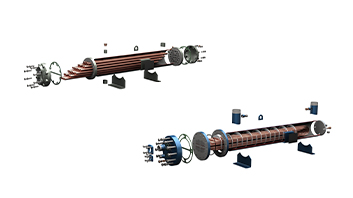
Shell and tube heat exchangers are among the most widely used heat exchangers in industrial facilities due to their robust construction and designs resistant to high pressure. However, the same design is not suitable for every application; the properties of the fluid, temperature difference, and maintenance requirements play a significant role in determining the correct type.
So which design is more suitable for which system?
Fixed Tube Sheet Heat Exchanger
In fixed tube sheet heat exchangers, the tubes are fixed to the shell, and the system operates as a single unit. Thanks to their simple and compact structure, they are an economical solution. They can be safely preferred in systems using clean fluids. However, since the tube side cannot be mechanically cleaned, they are not suitable for applications with a risk of fouling. They are generally used in clean water cooling systems and processes requiring low maintenance.
U-Tube (U-Bundle) Heat Exchanger
In the U-tube design, the tubes are formed in a U shape and connected to a single tube sheet. This structure provides an advantage against thermal expansion, especially in systems with high temperature differences. It offers a reliable solution in processes where thermal stress is high. However, cleaning the inside of the tubes may be limited. They are frequently preferred in steam applications and systems with high temperature differences.
Floating Head Heat Exchanger
In floating head heat exchangers, the tube bundle has a removable structure. This feature facilitates maintenance and cleaning operations. It provides a reliable solution in systems containing dirty, fouling, or oily fluids. Although the initial investment cost is higher compared to other types, it offers maintenance advantages in the long term. It is widely used in seawater applications, petrochemical plants, and processes requiring frequent maintenance.
Double Pipe Heat Exchanger
In double pipe heat exchangers, one pipe is positioned inside another. With their simple and modular structure, they provide an effective solution for small-capacity applications. They may not be economical for large industrial capacities; however, they are a practical alternative for pilot systems and low-flow processes.
Which Shell and Tube Heat Exchanger Should Be Preferred Where?
Heat exchanger selection does not depend solely on capacity. The cleanliness of the fluid, temperature difference, maintenance needs, and operating conditions must be evaluated together.
The table below provides general guidance:
Application Type and Recommended Design
- Clean water cooling: Fixed Tube Sheet
- High temperature difference: U-Tube
- Dirty / fouling fluid: Floating Head
- Seawater: Floating Head (with appropriate material)
- Small capacity: Double Pipe
This table provides a general framework; the final selection should be determined through engineering analysis based on application conditions.
Why Is the Design Type Important?
Choosing the wrong design can lead to performance loss, increased maintenance costs, and a shortened system lifespan. Thermal expansion problems and tubes that cannot be cleaned can create serious operational issues in the long term.
In terms of long-term operating costs, the design type is a critical parameter. Therefore, heat exchanger selection should be based not only on capacity calculations but also on determining the correct design type.
Conclusion
Shell and tube heat exchangers provide solutions to many industrial needs with different design options. When the correct design is selected:
-
Longer equipment lifespan
-
Lower maintenance costs
-
More stable performance
-
Safer operation
As Refkar, we determine the most suitable shell and tube heat exchanger design for your application through detailed engineering analysis and deliver long-lasting solutions.