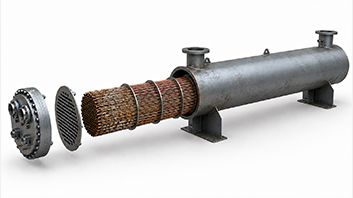
Shell & tube heat exchangers stand out as a reliable heat transfer solution in industrial systems, thanks to their high-pressure-resistant structures and long-lasting designs. However, under demanding operating conditions — especially with dirty or particle-laden fluids — buildup on tube surfaces over time is inevitable. These deposits reduce heat transfer efficiency, increase energy consumption, and can cause long-term equipment damage. Regular cleaning and maintenance therefore becomes a critical requirement for preserving system performance.
Why Does Fouling Occur in Shell & Tube Heat Exchangers?
Fouling on the inner surfaces of tubes largely originates from the nature of the fluid used in the system. Limescale buildup is common in systems operating with hard water, while oily or solid-particle containing fluids can form layers on tube inner surfaces. In corrosive environments, rust and oxidation products are also among the primary factors causing buildup over time.
These deposits directly impede heat transfer between the two fluids, causing the system to consume more energy.
How Do We Know Cleaning Is Needed?
The need for maintenance in shell & tube heat exchangers typically manifests through noticeable changes in system performance. The most common indicators are:
- Deviation from expected outlet temperatures
- A significant increase in pressure drop
- Energy consumption rising above normal levels
- Irregular or unstable system operation
When these symptoms are observed, the heat exchanger should be inspected and the maintenance plan reviewed.
Cleaning Methods
Chemical Cleaning (CIP – Cleaning in Place)
Chemical cleaning is a practical method that can be applied without removing the heat exchanger from the system. Appropriate chemical solutions are circulated through the tube interiors and shell side to dissolve limescale, organic residues, and corrosion products. It is frequently preferred for regular periodic maintenance because it minimizes operational downtime.
It is critically important that the chemical used is compatible with the tube and shell materials to avoid damaging the equipment.
Mechanical Cleaning
In cases of heavy fouling where chemical cleaning is insufficient, mechanical cleaning comes into play. In this method, the heat exchanger is taken offline and the tubes are cleaned one by one with mechanical equipment, brushes, or high-pressure water. One of the greatest advantages of the shell & tube design is its accessible structure, which allows for this procedure.
Although mechanical cleaning requires more labor and time, it offers the most effective solution for extensive fouling.
Hydroblasting (High-Pressure Water Jetting)
Particularly for large-diameter and long tubes, high-pressure water jet application is preferred as both a fast and effective cleaning method. It physically removes solid deposits and hard limescale layers without dissolving them.
How Often Should Cleaning Be Performed?
The cleaning interval varies depending on the system’s operating conditions and fluid characteristics. Systems operating with hard water, oil, or particle-containing fluids may require more frequent maintenance. As a general approach, a detailed inspection at least once a year is recommended; however, for critical production lines, this interval should be determined by monitoring system performance and kept shorter.
Key Considerations During Maintenance
Minor mistakes during the maintenance process can cause serious equipment damage. Therefore, attention should be paid to several fundamental points:
- Abrasive equipment that could damage tube surfaces should be avoided.
- Chemicals should be selected after verifying material compatibility.
- Reassembly of disassembled parts must be done in accordance with the manufacturer’s torque and tightening specifications.
- Gaskets and fasteners should be visually inspected at every maintenance and replaced if worn.
- After cleaning, the system should be commissioned with a leak test.
Advantages of Regular Maintenance
Timely cleaning and maintenance not only extends equipment life, but also ensures the system operates at its design efficiency under all conditions. Clean tube surfaces maximize heat transfer while minimizing energy costs. Additionally, unplanned shutdowns and costly emergency repairs are prevented.
Conclusion
Regular cleaning and maintenance of shell & tube heat exchangers is one of the cornerstones of system reliability. Maintenance work carried out with the correct methods and intervals keeps efficiency intact while keeping operating costs under control. Since every system has different needs, customizing the maintenance plan according to operating conditions will be the healthiest approach.