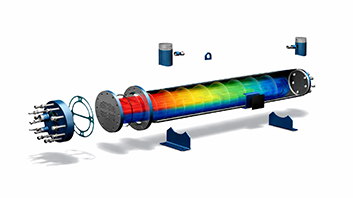
Shell-and-tube heat exchangers are among the most established and reliable heat transfer systems, enabling two different fluids to exchange heat without mixing with each other. The basic operating principle is based on one fluid flowing through the tubes, while the other fluid flows outside the tubes on the shell side.
Heat transfer occurs along the tube surface through conduction and convection mechanisms, depending on fluid motion. In this way, controlled, safe, and efficient heat exchange is ensured even under high temperature and high pressure conditions.
Operating Modes According to Flow Arrangement
One of the most important factors affecting heat transfer efficiency in shell-and-tube heat exchangers is the flow arrangement:
• Parallel Flow:
Both fluids enter the heat exchanger from the same direction. Although rapid heat transfer is achieved initially, the outlet temperature difference is limited.
• Counterflow:
The fluids move in opposite directions. This arrangement creates a higher average temperature difference, providing maximum heat transfer efficiency and is the most commonly preferred method in industrial applications.
Single-Pass and Multi-Pass Designs
Shell-and-tube heat exchangers can be designed with different numbers of passes depending on process requirements:
• Single-pass systems are preferred for simple applications with low pressure drop.
• Multi-pass systems increase flow velocity and turbulence, thereby enhancing heat transfer performance.
This flexibility allows shell-and-tube heat exchangers to be easily adapted to different capacities and process conditions.
Role of the Shell and Tube Structure
• The tubes form the primary heat transfer surface and are typically manufactured from copper, copper-nickel alloys, stainless steel, carbon steel, or special alloys.
• The shell directs the second fluid flowing around the tubes, providing flow control within the heat exchanger.
Thanks to this robust and modular structure, shell-and-tube heat exchangers can operate safely for many years under high pressure, high temperature, and aggressive fluid conditions. This operating principle makes shell-and-tube heat exchangers an indispensable heat transfer solution, especially in critical industrial processes.