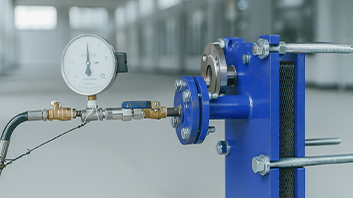
Plate heat exchangers are sensitive devices that operate with high efficiency. Post-production quality control, pre-commissioning tests, and post-maintenance checks ensure the safe and long-lasting operation of the equipment.
Testing methods are applied under different headings focusing on leak tightness, pressure resistance, and performance.
Pressure Test
Purpose: To verify the resistance of the plates, gaskets, and casing structure to the operating pressure.
How is it Performed?
-
The heat exchanger is filled with water.
-
The determined test pressure (usually 1.3 – 1.5 times the design pressure) is applied.
-
The pressure is held constant for a specific duration, and checked for leaks.
Result: The device passes the test if there is no leakage or deformation.
Leak Tightness Test
Purpose: To detect if the gaskets are correctly seated and if there are any leaks at the plate connections.
Methods
-
Vacuum test: Pressure drop is observed under vacuum.
-
Gas test: Helium, nitrogen, or air is used to pinpoint leak locations.
Advantage: A sensitive method for detecting especially low-pressure leaks.
Visual and Non-Destructive Examination
Purpose: To inspect the surface condition of the plates, corrosion, and mechanical damage.
Methods
-
Visual control (scratches, deformation, corrosion)
-
Penetrant testing (crack detection)
-
Magnetic particle testing (for ferromagnetic materials)
Advantage: Damage can be early diagnosed without dismantling the plates.
Gasket Control
Purpose: To check gasket elasticity, seating surfaces, and possible deformations.
Method: Performed through gasket hardness measurements, visual inspection, and leak tightness testing after assembly.
Importance of Testing
-
Ensuring safe operating conditions
-
Maintaining energy efficiency
-
Preventing unscheduled downtime and maintenance costs
-
Compliance with standards (e.g., PED, ASME)
Testing Processes with Quality Standards at Refkar
As Refkar, we carry out all testing processes in plate heat exchangers, from production to commissioning, in accordance with engineering standards.