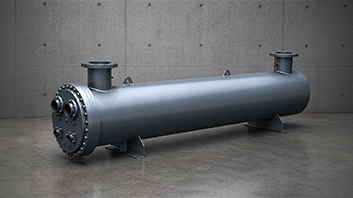
Shell & tube heat exchangers are preferred in many industrial applications due to their robust structure and flexible design advantages. However, they are not the ideal solution for every system. So, in which specific cases should you choose a shell & tube design?
1. High Pressure and Temperature Applications
Shell & tube heat exchangers:
- Are resistant to high pressure.
- Operate stably at high temperatures.
Because of this, they are among the most reliable options for harsh conditions such as steam systems, power plants, and petrochemical facilities.
2. Fluids Containing Fouling or Particles
If the fluid contains:
- Sediment
- Solid particles
- A high risk of calcification/scaling
Then shell & tube heat exchangers should be selected. They offer a lower risk of clogging, allow for mechanical cleaning, and provide a longer service life.
3. Large-Scale Heat Transfer Requirements
In high-flow and large-scale systems, they:
- Offer a wide surface area.
- Provide high heat transfer capacity.
They are ideal for industrial cooling, central systems, and process lines.
4. Systems Using Different Types of Fluids
Shell & tube heat exchangers can operate efficiently with various combinations:
- Liquid–Liquid
- Gas–Liquid
- Steam–Liquid
This flexibility gives them an extremely wide range of applications.
5. Systems Where Thermal Expansion is an Issue
Under high temperature differences:
- Materials expand.
- Mechanical stresses occur.
Thanks to U-tube and floating head designs, shell & tube heat exchangers easily tolerate these stresses.
6. Applications Requiring Long Life and Durability
If your system:
- Operates 24/7.
- Is part of a critical production line.
- Has high downtime costs.
Then shell & tube heat exchangers offer a secure, long-term investment.
7. Systems Requiring Easy Maintenance and Service
In shell & tube heat exchangers:
- Tubes can be cleaned.
- Parts can be replaced.
- Overhauls and revisions can be performed.
This reduces the total cost of ownership.
When Should They NOT Be Preferred?
Alternative solutions may be better if:
- Space is very limited.
- A more compact solution is required.
- There is low pressure and clean fluid.
In these cases, plate heat exchangers may be more advantageous.
Conclusion
Shell & tube heat exchangers are one of the most accurate choices for systems with:
✔ Harsh operating conditions
✔ High pressure and temperature
✔ Fouling/Dirty fluids
✔ Large capacity requirements