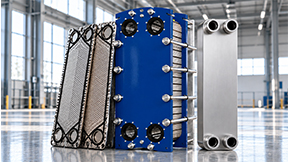
Plate heat exchangers are used in many industries, from HVAC and food processing to chemicals and energy, because they are compact, transfer heat efficiently and have a modular design. You only get these benefits on site, though, if the unit is correctly selected for the application.
Choosing the wrong plate heat exchanger leads to insufficient capacity, high pumping energy, early corrosion, gasket leaks and frequent maintenance. So which technical criteria should you check to make the right choice? Let’s go through them step by step.
1. Process Data: Capacity, Flow Rates and Temperatures
The first step is to fully define the process data for both the hot and cold sides. The thermal calculation is based on this data. If the data is missing or estimated, you end up with a unit that is either oversized or too small.
- Heat duty (kW): The amount of heat that needs to be transferred.
- Flow rates (m³/h or kg/s): The flow on each side.
- Inlet and outlet temperatures (°C): At least three of the four temperatures must be known.
- Operating mode: Does the system run continuously, under variable load or seasonally?
A key advantage of plate heat exchangers is that true counter-current flow allows approach temperatures between the hot and cold sides as low as 1–2 °C. However, as the approach temperature gets smaller, the required heat transfer area, and with it the cost, rises quickly. Target temperatures should therefore be based on what the process actually needs.
You should also share the minimum and maximum load conditions. In systems with summer–winter differences or changing loads, the heat exchanger needs to stay efficient across the whole operating range, not just at the design point.
2. Fluid Properties and Allowable Pressure Drop
The nature of the fluid directly affects both thermal performance and material selection. The same design cannot be used for water, glycol, oil, seawater and chemical solutions.
- Fluid type and concentration: Glycol concentration (e.g. 30% or 40%) changes heat transfer capacity and viscosity.
- Viscosity: With high-viscosity fluids (oil, syrup, etc.), the heat transfer coefficient drops and pressure drop rises.
- Particle and fibre content: These can clog narrow plate channels. In that case, wide-gap plates should be considered.
- Chloride content and pH: These are critical inputs for choosing the plate material.
Pressure drop is the parameter most often overlooked during selection. In plate heat exchangers, high turbulence means both high heat transfer and high pressure drop. A low allowable pressure drop means more plates are needed. A high one makes the unit smaller but increases pumping energy.
3. Plate and Gasket Materials
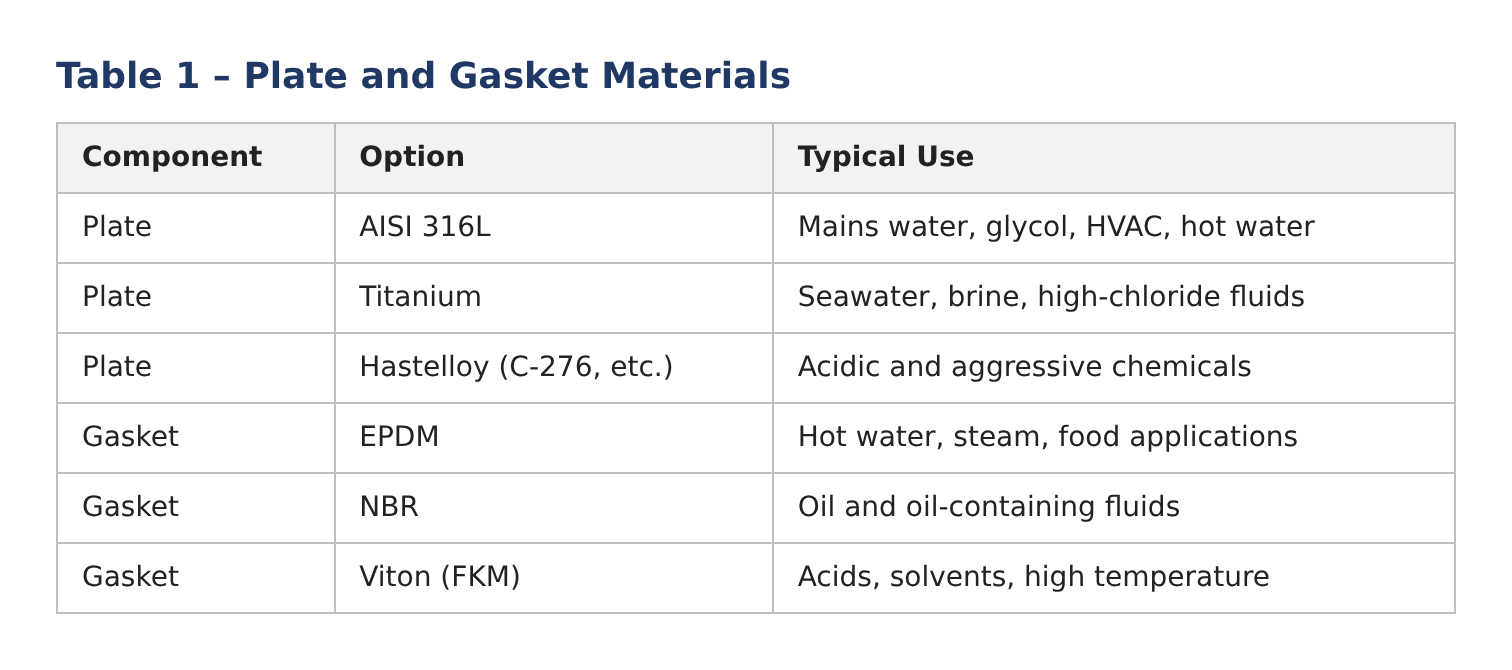
Typical plate and gasket material options by application. Final selection depends on fluid chemistry, temperature and chloride content.
Keep in mind that a durable plate is not enough on its own. For example, an EPDM gasket can swell in an oily fluid and start leaking within a short time. The cleaning chemicals used during maintenance must also be compatible with both the plate and the gasket.
For more detail, see our articles Plate Material Selection and Gasket Types in Plate Heat Exchangers.
4. Construction Type and Plate Pattern
Plate heat exchangers fall into three main groups based on how they are sealed. Each one suits different applications.
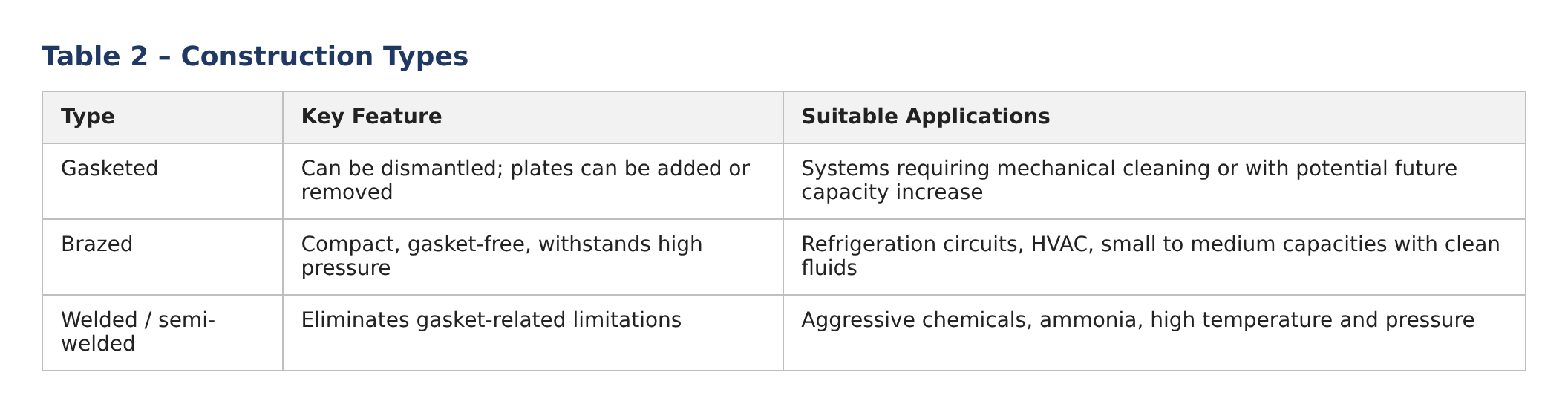
Comparison of gasketed, brazed and welded plate heat exchangers by key feature and typical application.
Brazed heat exchangers can’t be cleaned mechanically, so they should be used with care for dirty or particle-laden fluids. Where ease of maintenance is a priority, the gasketed type is usually the better choice.
The plate pattern (chevron angle) also has a direct effect on performance. Steep-angle (“hard”, H-type) plates give higher turbulence and heat transfer but increase pressure drop. Wide-angle (“soft”, L-type) plates run with lower pressure drop. A good thermal design mixes the two plate types (M-type channel) to strike the best balance between capacity and pressure drop.
The connection port diameter should also be checked. If port velocity is too high, it can cause uneven distribution between the plates, extra pressure drop and erosion.
5. Design Conditions, Fouling Margin and Ease of Maintenance
Design pressure and temperature: The heat exchanger should be selected for the highest pressure and temperature that can occur in the system. Normal operating values are not enough. Pump start-ups, water hammer and the pressure difference between the two sides should also be taken into account. In gasketed types, the temperature limit is usually set by the gasket material.
Fouling margin: The high turbulence in plate heat exchangers reduces fouling noticeably compared with shell-and-tube units. Adding too much extra surface area can lower channel velocities and actually increase fouling. The fouling margin should be kept at a reasonable level based on the actual nature of the fluid.
Maintenance and expansion: For gasketed heat exchangers, choosing a frame long enough to take extra plates lets you increase capacity later without buying a new unit. CIP connections, service space and lead times for spare parts (plates, gaskets) should also be considered at the selection stage. For maintenance procedures, see our Cleaning and Maintenance Guide for Plate Heat Exchangers.
Standards and certificates: Depending on the application, you should ask for pressure equipment (PED) compliance, hygienic design for food applications, and material certificates. Our article Test Methods for Plate Heat Exchangers covers the pressure and leak tests carried out before delivery in detail.
Checklist Before Requesting a Quote
Having the following information ready makes the thermal calculation quick and accurate: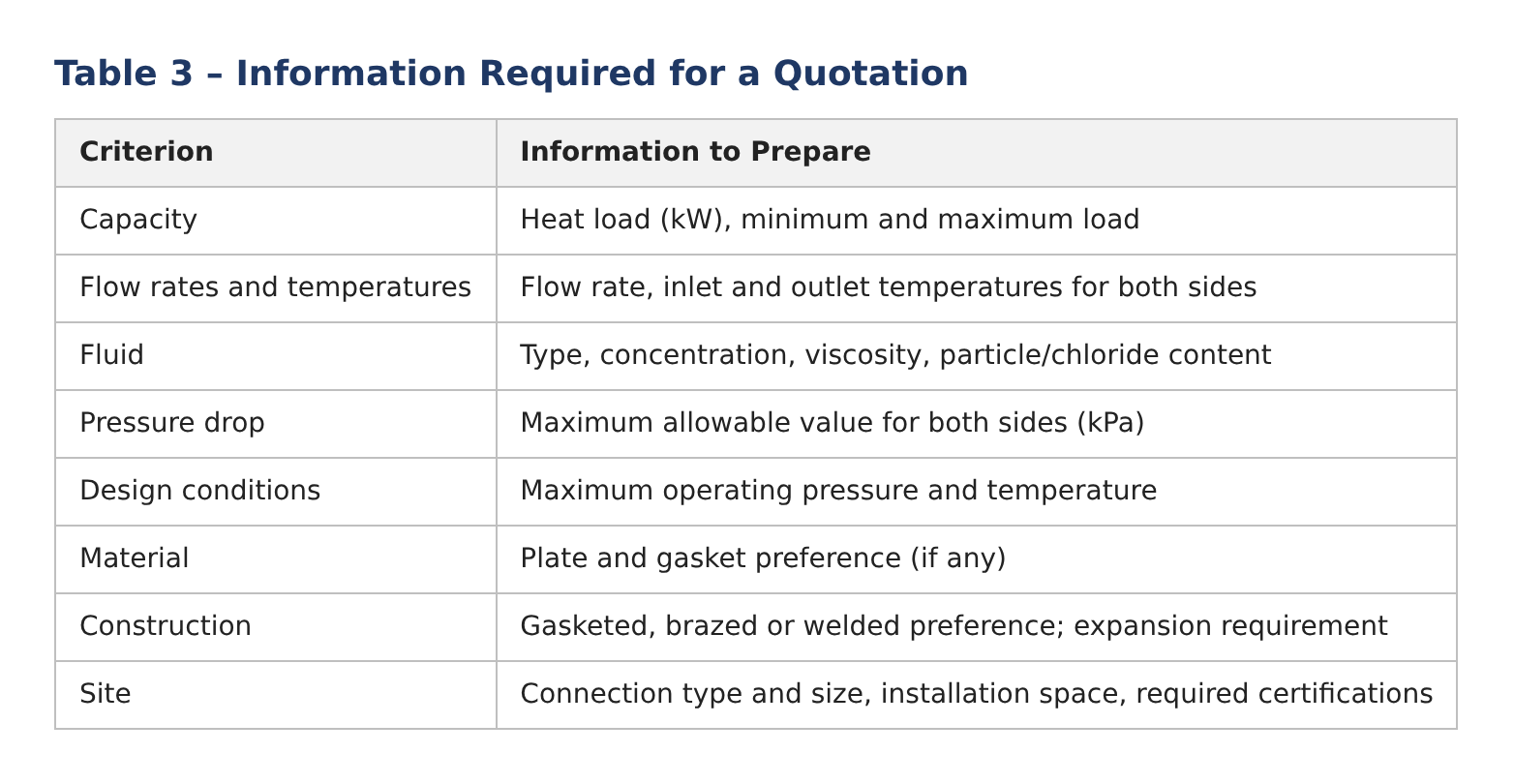
Checklist of process data to share with your supplier for an accurate thermal calculation and quotation.
Conclusion
Selecting a plate heat exchanger is about more than a capacity figure. It is an engineering process that weighs process data, fluid properties, materials, construction and maintenance needs together. A correctly selected heat exchanger pays back through low operating costs and many years of trouble-free operation.
At Refkar Soğutma, we run thermal calculations based on your process data and choose the plate, gasket and construction type for your specific application. Contact us for technical support for your project.